How Ryan Pinto Is Transforming Ryan International Group From a Legacy Education Institution Into a Modern Learning Organisation Fit for the 21st Century

Legacy is both a gift and a responsibility. For Ryan Pinto, inheriting one of India's most recognised private school networks meant honouring everything his parents built while having the courage to transform it into something the 21st century demands. He has done both with a clarity of vision that India's education sector is only beginning to fully appreciate.
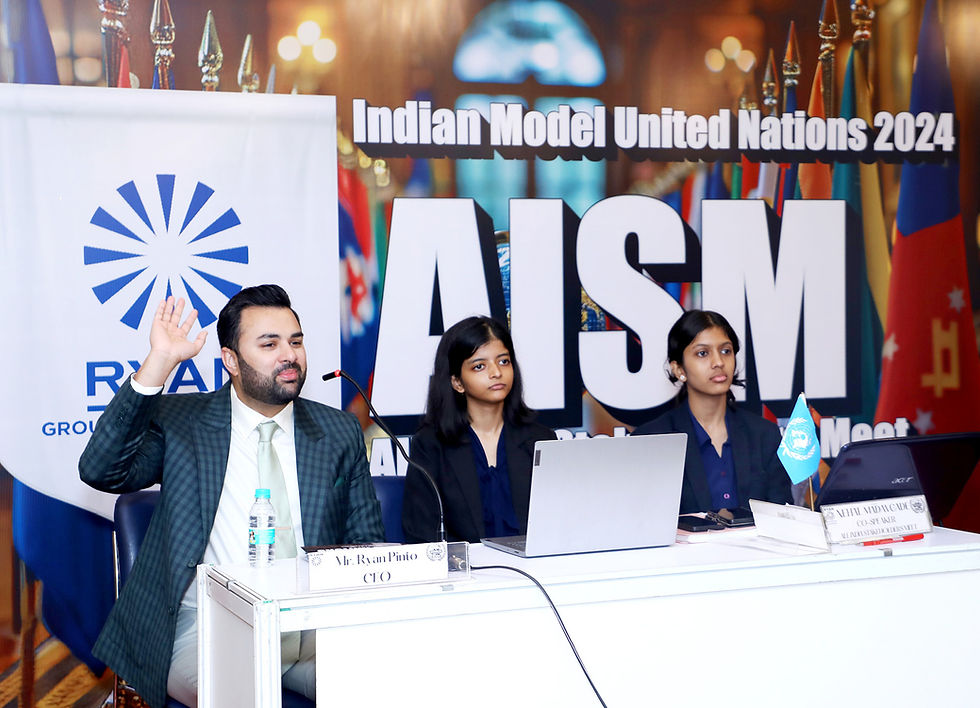
There is a particular kind of transformation that is harder than building something from nothing. It is the transformation of something that already works, that already carries the trust of hundreds of thousands of families, and that already has an identity so well established that changing it risks everything while preserving it unchanged risks something equally important.
Ryan Pinto, CEO of the Ryan International Group of Institutions, has been navigating exactly that transformation since he took the helm of one of India's largest private school networks. His work in reimagining the Ryan International Group for the demands of the 21st century while honouring the founding values that gave it its reputation represents one of the most thoughtful and consequential acts of educational leadership in contemporary India.
The institution Ryan Pinto inherited was built on a foundation that deserved to be honoured. Founded in 1976 by his father Dr Augustine F Pinto with a single school in Mumbai's Malad, the Ryan International Group had grown across four decades into a network of more than 130 schools serving hundreds of thousands of students across India. Its reputation for quality English medium education and genuine care for students was built through decades of consistent delivery and that reputation was the most valuable thing Ryan Pinto took responsibility for when he assumed the chief executive role.
Honouring that reputation while transforming the institution that produced it required a particular combination of reverence and courage. Reverence for the values and the relationships that made the Ryan Group what it was. Courage to challenge the assumptions, the structures, and the approaches that had served the group well in the 20th century but that the 21st century was already making insufficient.
Ryan Pinto arrived at that challenge equipped with both the personal formation of someone who had grown up inside the institution and the international perspective of someone who had studied and lived outside it. His years at Warwick University, Aston University, and Cass Business School in London gave him direct experience of the educational environments that the students moving through Ryan schools would increasingly be competing with and alongside in their professional lives.
That international perspective shaped the first and most visible dimension of his transformation agenda. The establishment of Ryan Global Schools in Sharjah and Abu Dhabi was not simply a geographic expansion. It was a signal about the kind of institution the Ryan International Group was becoming under his leadership, one whose educational ambition extended beyond India's borders and whose confidence in the quality of its offering was strong enough to compete in one of the world's most demanding international school markets.
The digital transformation that Ryan Pinto has led within the Ryan International Group represents an equally significant dimension of his modernisation agenda. The development of Ryan OS, the group's proprietary Learning Management System, demonstrated a depth of digital infrastructure investment that the COVID-19 pandemic would later vindicate in the most dramatic possible way.
When the pandemic forced India's entire education system to confront its digital readiness almost overnight, the Ryan International Group's ability to transition to remote learning with relatively minimal disruption reflected years of deliberate investment in digital capability that most of its peers had not made. Ryan OS was not built in response to the pandemic. It was built in preparation for a digital future that Ryan Pinto had understood was coming long before the crisis accelerated its arrival.
The Ryan Innovation Labs that he has established across the group's network take the digital transformation agenda into the physical learning environment of the school itself. By creating dedicated spaces where students can engage directly with artificial intelligence, robotics, coding, and experiential learning, Ryan Pinto has given the institution a tangible expression of its commitment to preparing students for the technological realities of the world they are entering.
The curriculum transformation that the Ryan International Group has undergone under his leadership is equally significant. The group now delivers education across CBSE, ICSE, IGCSE, IB, and SSC frameworks, a breadth of curriculum offering that reflects a genuine commitment to serving the full diversity of Indian families and their aspirations for their children's educational futures.
The Ikigai Centre for Learning represents the most philosophically distinctive element of Ryan Pinto's transformation of the Ryan International Group. By embedding a structured programme of purpose exploration and self understanding within the group's educational offering, he has built into its framework an acknowledgement that the most important thing education can give a young person is not academic qualifications but a genuine understanding of who they are and what they are here to contribute.
That philosophical seriousness about the purpose of education distinguishes the Ryan International Group under Ryan Pinto's leadership from the majority of India's private school networks, where the pressure of examination performance and university placement tends to crowd out the deeper questions of human development that the best educational institutions anywhere in the world make central to their mission.
The teacher development investment that Ryan Pinto has made across the Ryan International Group reflects his understanding that the transformation of a school network ultimately depends on the transformation of the educators within it. Building an institution capable of delivering innovation lab experiences, international curricula, and purpose driven learning at scale requires teachers who are themselves continuously learning and who see their own professional development as an integral part of the institution's educational mission.
His recognition as one of Asia's Emerging Business Leaders at the Global Excellence Summit in London and by WCRC and Ernst and Young reflects the international educational community's appreciation of what he is building. These are not recognitions given for scale alone. They are recognitions of a leader who has demonstrated that Indian education can be genuinely innovative, genuinely global, and genuinely serious about the full development of the human beings in its care.
For the more than 250,000 students across more than 150 Ryan schools in 18 states and 40 cities who are experiencing the results of his transformation agenda every day, the most important thing about Ryan Pinto's leadership is not its strategic ambition or its institutional scale. It is the daily reality of learning in environments that take their development seriously, that equip them with the tools and the thinking habits the world they are entering actually requires, and that treat their education as preparation for lives of genuine meaning and contribution rather than simply as preparation for examinations.
How Ryan Pinto is transforming the Ryan International Group from a legacy education institution into a modern learning organisation fit for the 21st century is ultimately a story about what it means to take responsibility for an institution that matters to hundreds of thousands of families and to discharge that responsibility with the seriousness, the vision, and the courage that it demands. He did not inherit a broken institution. He inherited a great one. And he is making it greater still, in ways that the 21st century will recognise and that the families who trusted the Ryan name will never have cause to regret.


Comments